 e80f7b287b
The old logo was a thin monoline wordmark in a ring, with a grey gradient. The
kernel draws include/logo.h as a 128x128 four-bit coverage mask, so hairlines at
that size go ragged, the ring spent most of the area on nothing, and at small
sizes the S read as a 5.

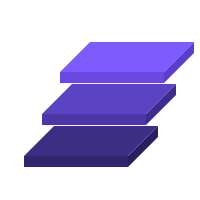
Three marks, because each depicts the thing it belongs to and so they stop
competing:

  Shift       three slabs, displaced. The layer diagram in
              docs/architecture/README.md as a solid object, and the kernel's
              name as a shape. Dimensional rather than flat -- the tradition
              Paul Rand's NeXT cube belongs to, which is what the architecture
              already claims as its model.
  Uberblock   the SchFS ring: twelve slots, one of them newest. Twelve so the
              slots divide 360 exactly; an arbitrary count leaves a part slot
              crammed against its neighbour where the ring closes. The newest
              is marked by REACHING FURTHER OUT as well as by colour, because
              colour is exactly what the coverage mask discards.
  Guru        the PSOGM face, drawn for reference. Not wired in: panic.c argues
              for the ":(" on the grounds that it is "legible as a mood without
              being a picture of anything", and Guru spends that. Worth deciding
              on purpose.

mklogo.py reads ink as (255 - luminance) * alpha, so tones survive as *coverage*
rather than being flattened -- which means the old grey gradient was not
discarded, it was turned into partial transparency. It also inverts: darkest is
most ink, which the kernel draws brightest. The mask source is therefore a
separate greyscale file with the top slab darkest, or the object would be lit
from below. Two files sharing one geometry is a drift hazard and the desc in
both says so.

The splash gets it for free: ui_logo() shades per row with metal() and the
mask's own tones reinforce that gradient rather than fighting it, so the slabs
come out looking machined.

Co-Authored-By: Claude Opus 5 <noreply@anthropic.com>
Claude-Session: https://claude.ai/code/session_01VQ7Qx8E1q1M1bbCq8QLHS2
27 lines
1.2 KiB
XML
27 lines
1.2 KiB
XML



<svg xmlns="http://www.w3.org/2000/svg" viewBox="0 0 200 200" width="200" height="200">
|
|
<title>SchOS — Shift</title>
|
|
<desc>Three slabs, displaced. The layer diagram in docs/architecture/README.md
|
|
as a solid object, and the kernel's name (SchIFT) as a shape.
|
|
|
|
Each slab shows three faces: the top, the front edge under its lower side, and
|
|
the right-end wall under its right diagonal. The right wall is not optional --
|
|
without it the slab has no thickness where it is widest, and the corner reads
|
|
as a hole rather than an edge.
|
|
|
|
Geometry is shared with "SchOS Shift Mask.svg"; see that file.</desc>
|
|
|
|
<!-- bottom slab -->
|
|
<path fill="#3C2E85" d="M54 126 L158 126 L128 156 L24 156 Z"/>
|
|
<path fill="#31256E" d="M24 156 L128 156 L128 167 L24 167 Z"/>
|
|
<path fill="#291F5C" d="M158 126 L158 137 L128 167 L128 156 Z"/>
|
|
|
|
<!-- middle slab -->
|
|
<path fill="#5B44C4" d="M72 84 L176 84 L146 114 L42 114 Z"/>
|
|
<path fill="#4B37A6" d="M42 114 L146 114 L146 125 L42 125 Z"/>
|
|
<path fill="#3F2D8C" d="M176 84 L176 95 L146 125 L146 114 Z"/>
|
|
|
|
<!-- top slab -->
|
|
<path fill="#7C5CFF" d="M90 42 L194 42 L164 72 L60 72 Z"/>
|
|
<path fill="#6949E0" d="M60 72 L164 72 L164 83 L60 83 Z"/>
|
|
<path fill="#5B3FC9" d="M194 42 L194 53 L164 83 L164 72 Z"/>
|
|
</svg>
|